
Taken 7-3-2024
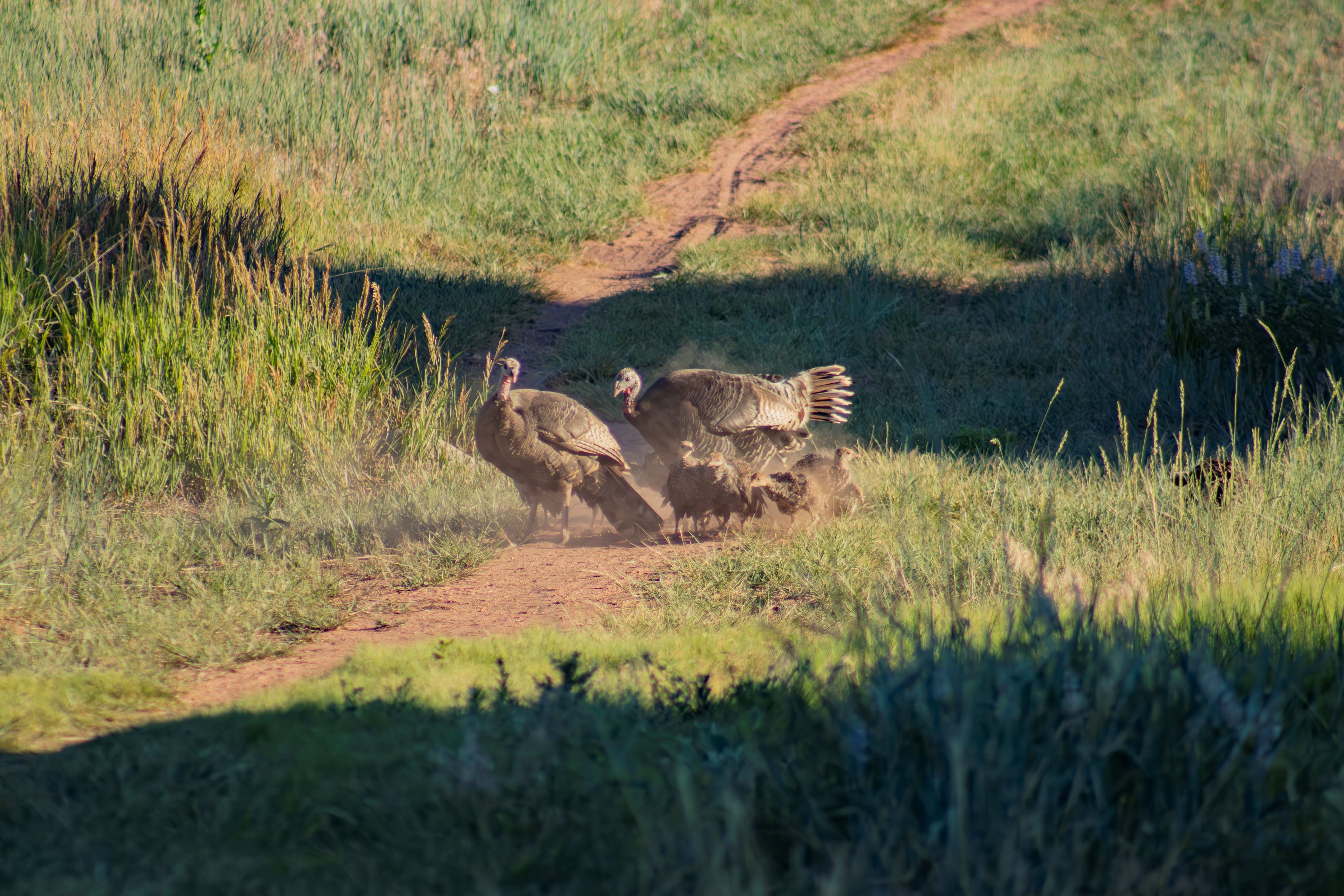
Merriam's Wild Turkeys:
The United States is home to several different subspecies of wild turkeys. Pictured above is a family of Merriam's wild turkeys, which are most commonly found in the western States. Most male turkeys (AKA toms) have a tuft of long, hair-like feathers sticking out of their chests called beards, while most female turkeys (AKA hens) do not. However, bearded hens and beardless toms are not uncommon.
Contrary to popular belief, wild turkeys can fly and roost at night in trees. They're not long-distance fliers, but they can fly up to 300 yards and reach speeds of up to 55 miles per hour. Most of the time, however, turkeys prefer to stay on the ground during the day, and only fly in the evenings to roost in the trees, away from predators.
One can also tell a wild turkey's mood by the color of their heads. If a turkey's head is red and/or white, it signals that they are in an excited or angry state. If a turkey's head is a darker shade of blue, it signals that its relaxed, but not threatened. If a turkey's head turns a pale shade of blue, it signals that it feels afraid and/or submissive.
Evidently, the family of Merriams I photographed were feeling quite relaxed as they bathed in the ancient red sand.
Also, wild turkeys are classified as game birds, which means that while hunting them is strictly regulated, it is perfectly legal to collect their feathers.
